
Foard Scheduled and Actual Release
The TDCJ definitions describe a projected release date as the date an incarcerated person is expected to leave if not paroled sooner and if the date is not changed by the loss of good-conduct time. It is a forecast within the state-prison system. An actual release date records the event after the person leaves TDCJ, a county jail, or another custodian.
A parole-eligibility date is different again. It marks when the Board may consider a case, not when release must occur. A favorable vote can carry program or processing conditions. A discharge date means the sentence or supervision obligation ended. Each term answers a different question.
A Foard pretrial detainee usually has no computed release date because the case has not reached a final sentence. Bond, dismissal, plea, transfer, or a later court order can change custody. Ask the holding jail for present status and the clerk for the controlling order.
Find a Foard Inmate Release Date
The right sequence avoids searching a prison database for a county detainee. Foard's current receiving jail is not named on the official Sheriff page, and dated Texas Commission on Jail Standards reports show local detainees housed outside the county. The first call should establish who physically holds the person.
- Ask the Foard County Sheriff to identify the receiving jail and provide the booking or transfer identifier.
- If the person remains in county custody, ask that jail and the court clerk about the sentence, bond, order, holds, and recorded release time.
- If transferred to TDCJ, use the TDCJ Inmate Search with last name and first initial, TDCJ number, or SID. Optional fields help separate matches.
- If the public result is unclear, use the TDCJ email information service with full name and TDCJ number, or exact birth date or approximate age and county of conviction.
- Near release, confirm the event with the custodian. After release, request the historical release or discharge record rather than relying on a blank current-custody result.
The TDCJ search screen below shows both its identity fields and its current-incarceration limit.
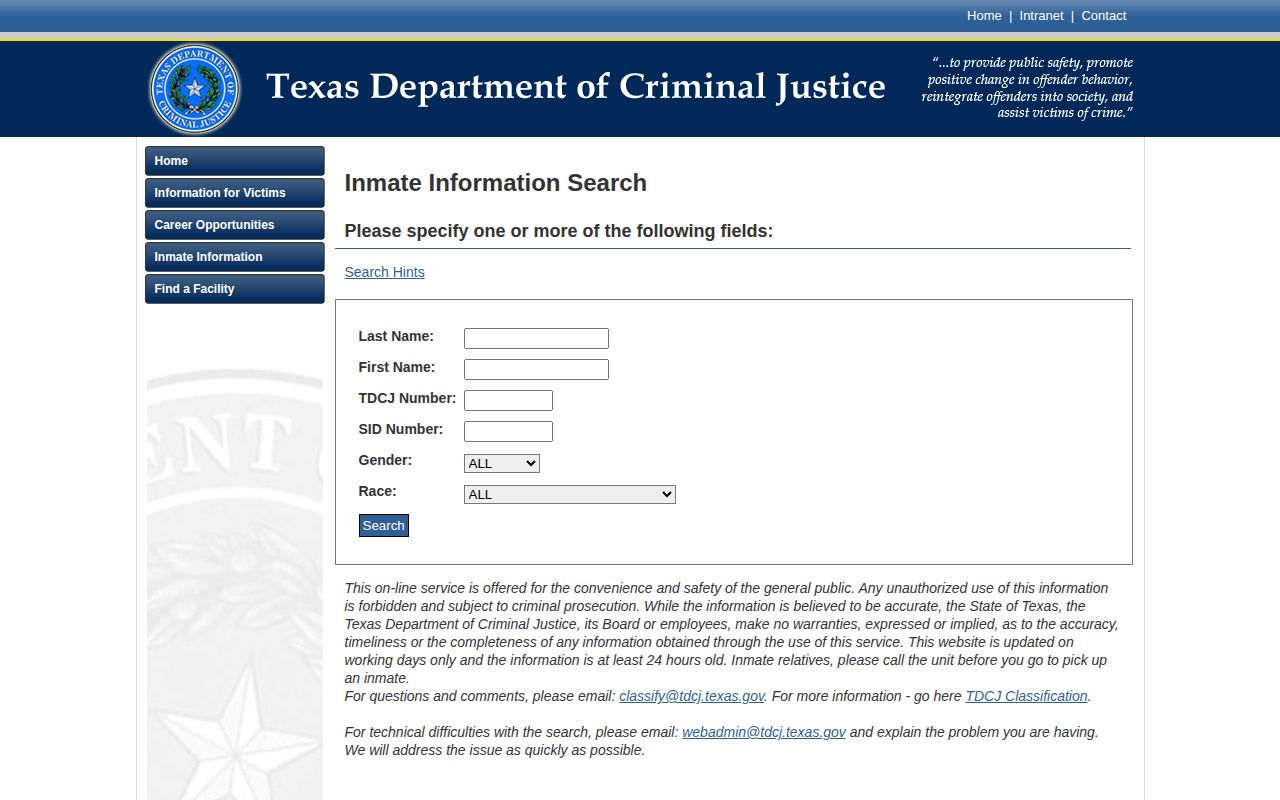
A former prisoner normally drops from this public search. TDCJ email, public-information records, court documents, and parole records then provide the longer trail.
A county sentence takes a separate route. The Foard Sheriff record should identify the booking, receiving facility, charge, court, release authority, release date and time, and any transfer destination. If the Sheriff does not hold the final exit record, ask which receiving jail does. The court record can establish the judgment and sentence, but the receiving jail supplies the physical departure event.
Federal custody uses another system. The Bureau of Prisons locator can show a past release date and a RELEASED result for many federal prisoners. ICE has its own detainee locator, while U.S. Marshals pretrial custody may require the federal docket and holding facility. Neither Texas IVSS nor the TDCJ search proves those release routes.
Foard TDCJ Date Request Fields
TDCJ's no-fee email service can return projected-release information for a current prisoner when the request supplies enough identity data. It may also return the TDCJ number, current location, conviction and incarceration facts, prior incarceration history, offense, county, and court. It does not provide photographs or Social Security numbers.
| Field | How it is used | Limit |
|---|---|---|
| Full name | Required identity starting point | Common names need more detail |
| TDCJ number | Best state-prison identifier | Seven digits for email request |
| SID | Alternative state identifier | Use when known |
| Date of birth | Fallback identity check | Exact date is preferred |
| County of conviction | Separates similar records | Foard may be one of several cases |
The official email-information page shown below documents the service and its projected-release output.
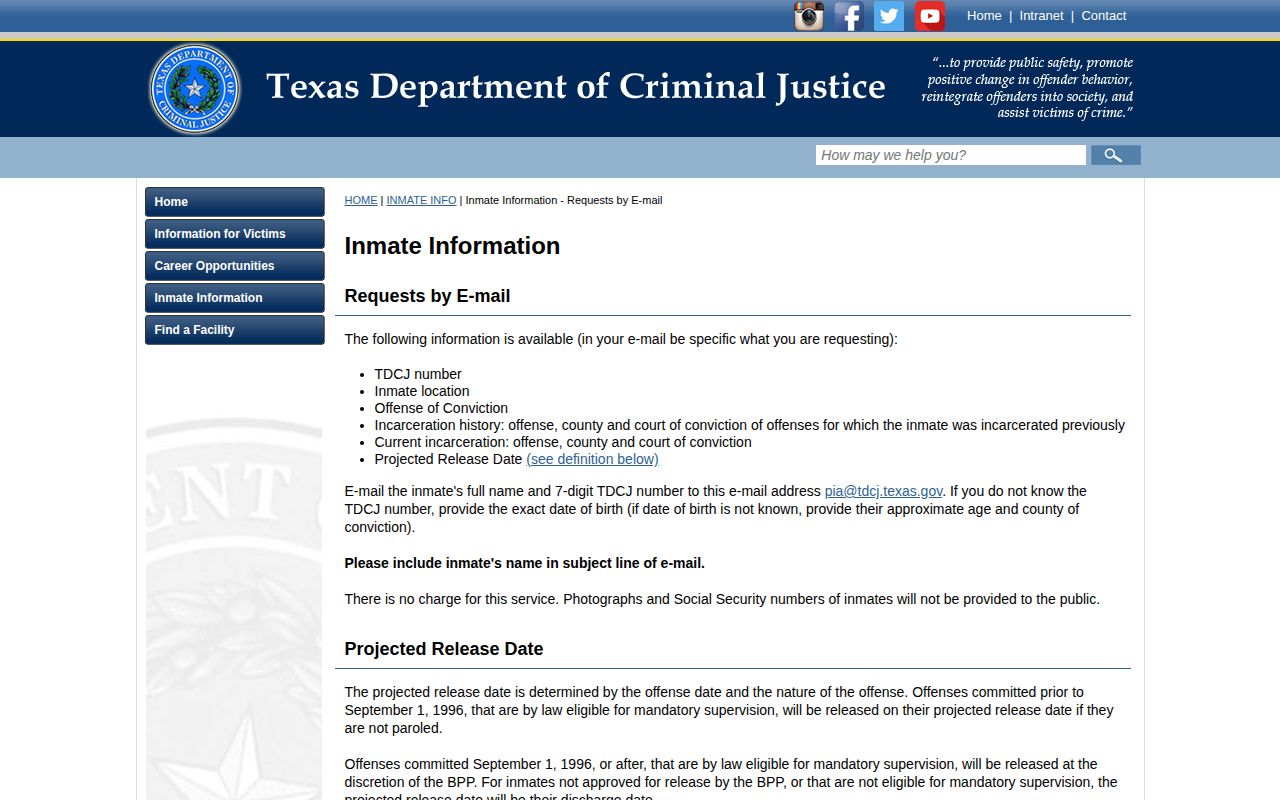
For a completed release, ask TDCJ's public-information office for the specific historical record. The email service is oriented to current information and should not be presented as a permanent released-person locator.
The request should name the fields needed: actual release date and time, releasing unit, release type, supervision status, discharge date if different, and transfer destination if any. Include the full name, TDCJ number or SID, date of birth, county of conviction, and a useful date range. The TDCJ public-information page provides form, email, mail, and in-person routes.
Note: A no-result response may mean release, a data mismatch, or the wrong custody system; it never proves the exit date.
Foard Release Date Credit Systems
Texas has two separate credit systems that can touch a Foard case. For a TDCJ sentence, Government Code Chapter 498 governs good-conduct time. This credit can affect parole or mandatory-supervision eligibility when the law permits. It does not simply erase part of the court's sentence, and it is not a promise of release on a calculator's result.
Parole eligibility is controlled by Government Code Chapter 508. Article 42A.054 of the Code of Criminal Procedure identifies offenses relevant to certain half-time or 30-year eligibility rules. Offense dates, sentence structure, exclusions, consecutive terms, and special statutes matter. Texas does not have one general rule that every prisoner must serve 85 percent, so an unsourced 85-percent shortcut is unsafe.
County-jail credit is different. Article 42.032 permits a sheriff, when its conditions apply, to grant good-conduct commutation that can deduct no more than one day for each day served. The decision is discretionary. Research found no Foard policy promising automatic half time. A county estimate must come from the Sheriff or receiving jail and the judgment, not from TDCJ's state-prison formula.
- Good-conduct time
- Credit governed by the relevant state or county rule for compliant conduct.
- Parole eligibility
- The point when discretionary Board review may occur.
- Detainer
- A request or hold from another authority that may block community release.
- Discharge
- Formal completion of a sentence or supervision obligation.
Why Foard Release Dates Change
A projected date is calculated from changing legal and administrative facts. The source of the change often tells the reader which office can explain it. TDCJ handles state credits and processing. A court controls its orders and judgment. Another agency controls its detainer.
| Factor | Possible effect | Best confirmation |
|---|---|---|
| Good-time loss or restoration | Moves a state projection or eligibility calculation | TDCJ record |
| Parole vote | May permit release, set a future date, require a program, or deny | Board status and TDCJ processing |
| Detainer or hold | Can lead to transfer instead of community release | Holding and requesting agencies |
| New court order | May alter authority or sentence calculation | Clerk-certified order |
| Consecutive sentence | Can extend custody beyond one case's date | Judgments and custodian |
| Administrative processing | Can separate a favorable action from gate release | Release-processing office |
A transfer is not a release. This matters in Foard County because a person may already be held in another county. The Foard booking record, receiving-jail record, and transfer destination should be read together.
A Board decision deserves special care. FI-1 permits release when eligible, while other favorable codes can set a future date or require a program or transfer. RMS concerns mandatory supervision. NR and SA are unfavorable actions with different next steps. The official vote-code page controls the meaning. None of these short codes, standing alone, supplies the gate time.
Other sentences can overlap. A detainer from another county, federal authority, or immigration enforcement may cause the person to leave TDCJ or a jail in agency custody rather than enter the community. Ask for the receiving custodian and transport event. That distinction prevents release from one record system from being misread as freedom from all custody.
Foard Weekend Release Rules Differ
The local distinction is easy to miss. Government Code §501.016(b) contains a weekend and holiday timing rule for eligible TDCJ prisoners whose scheduled date falls on specified days. That rule belongs to the state prison system. It does not establish a general Foard County early-weekend release practice.
For a county sentence, Article 42.032 good-conduct commutation and the receiving jail's calculation control. Article 42.033 also allows a judge to authorize intermittent confinement in specified circumstances, but that is a court arrangement, not proof that every county sentence ends early. No sourced Foard automatic half-time policy or universal weekend practice was found.
Ask the receiving jail for its calculated release date, any credit applied, the holding authority, and any other-agency hold. Then compare those answers with the judgment. This is the safest way to keep a state-only timing statute from being misapplied to a county detainee.
Note: The person may leave one custodian for another; ask whether the date means community release, transfer, or discharge.
Confirm Foard Physical Release
A final check should name the facility, date and time, release type, legal authority, and destination. For Foard county custody, request those fields from the Sheriff and actual receiving jail. Pair a judicial release order with the jail's exit time because authorization may precede physical departure.
For TDCJ, use the release or discharge record and, when supervision begins, the Parole Division. The separate state IVSS can send custody and parole notifications. The Foard VINELink release check explains the current IVSS-Counties and TDCJ IVSS split. An alert is timely corroboration, but the agency record supplies the formal release type.
If the public tools fail, submit a focused Texas Public Information Act request. State the full name, identifiers, custody date range, county of conviction, and exact fields sought. Ask for electronic copies. A clear request reduces confusion between a current status inquiry and historical proof.
Texas agencies may seek clarification when a request is broad, provide an estimate when charges are expected, and withhold information only under applicable law. Request an existing record instead of asking the custodian to create a new calculation. If the date is urgent, use both the status channel and written request, then document who supplied each fact.
When the answer arrives, label each date. A sentence end date, parole eligibility date, projected release date, favorable-vote date, discharge date, and actual jail exit time are not interchangeable. Record the agency, facility, time zone, and status beside each entry. If two official records conflict, ask both custodians whether one reflects a later update, a transfer, or a different sentence.
Keep the cause number with the court order and the booking or offender number with the custody record. This simple separation is vital in Foard County, where a local arrest can produce an out-of-county jail record and later a state record. A clear chain of identifiers makes the final release event easier to verify without guessing from a single portal.