
Foard County 72-Hour Release Status
No rolling Foard County 72-hour release view was found on the reviewed official Sheriff page, county sitemap, or bounded official-channel check as of August 2, 2026. No public update cadence, display-retention rule, field set, or booking-photo feed was documented. The safe substitute is not a commercial roster. It is a three-day request for existing records and a check with each agency that held the person.
The wider interval is useful when a family member knows an event happened over several days but not exactly when. It can capture a Friday-through-Sunday span in one request or bridge a holiday closure. Yet three days of roster removals are not a release list. Some entries may reflect transfers, record corrections, or a move to another custodian.
Check Foard County Three-Day Releases
Build the interval before calling. State the start and end in Central Time and list the identity details that can separate similar names. The Foard County Sheriff can identify the housing jail and whether its record shows release or a transfer. The physical custodian then confirms the gate event.
- Choose a fixed three-day span, such as midnight Friday through midnight Monday, instead of saying “recently.”
- Call the Foard County Sheriff's Office at 940-684-1501 during its posted weekday office hours.
- Ask which jail housed the person and obtain the booking identifier, Foard event time, release or transfer type, and destination.
- Contact the receiving jail for its custody log, actual release time, and any next custodian.
- Check the proper court file for the bond, dismissal, release order, judgment, or sentence entry that explains the legal result.
- Use Texas IVSS-Counties prospectively if Foard participation is available, but treat an alert as a lead rather than a three-day archive.
If the event should have occurred today and the date is known, the Released Last 24 Hours route uses a tighter request. Narrow requests reduce mistaken identity and may help the records custodian locate an existing entry.
Foard County 72-Hour Record Fields
There is no official online list whose displayed columns can be described. These are the existing record fields to seek across the three-day range, subject to what the Sheriff and receiving jail maintain and may disclose. Asking for the destination is essential because “release” may mean a change of custodian.
| Field to request | Why it matters over 72 hours |
|---|---|
| Full name, aliases, and booking ID | Keeps records for similar names from being combined. |
| Booking and event timestamps | Places each custody change inside or outside the defined span. |
| Housing or receiving jail | Points to the office holding the physical-custody record. |
| Release authority or type | Identifies bond, time served, dismissal, court order, sentence completion, or another recorded basis. |
| Transfer destination | Shows whether another jail, TDCJ, ICE, USMS, or other custodian received the person. |
| Court and cause number | Connects the event to the order or disposition that may explain it. |
Ask the Sheriff whether its timestamp is merely the end of Foard's entry or the receiving jail's actual discharge time. The two can differ. A court order establishes legal authority, while the custody record establishes what physically occurred and when.
Foard Weekend Release Reconciliation
A three-day interval is most valuable when normal office hours do not match jail operations. The Foard Sheriff page posts weekday office hours, but the research does not document an online feed cadence or promise when records appear. Do not claim that a result refreshes at a set time. Instead, define the period, then ask the agency for the timestamp recorded by the custodian.
Weekend processing can produce several relevant moments: a judge signs an order, Foard closes its local custody entry, a receiving jail clears a hold, and the person leaves the gate. Holidays can delay a public-record response without proving the jail event was delayed. Match the court record with the receiving jail's exit data once offices reopen.
For one person whose name or date is uncertain, the Foard County released-inmate lookup explains how to reconcile county, court, state, and federal channels.
Note: No official Foard web refresh schedule or 72-hour retention rule was found, so only the custodian's returned timestamp should be treated as authoritative.
Request Foard County Three-Day Records
Mail a narrow written request to Foard County Sheriff, P.O. Box 309, Crowell, TX 79227, or call first to confirm another accepted delivery method. The web contact form is not labeled as formal public-information intake. Ask for existing booking and release records from the exact start time through the exact end time. Include the desired electronic format and request an estimate before charges exceed a chosen limit.
Government Code Chapter 552 gives access to existing public information, subject to applicable exceptions. It does not force an office to compile a new “who got out” list from separate systems. If no countywide log exists, narrow the request by person. When Foard names one or more receiving jails, request each jail's custody entries for the relevant person and interval.
No local fixed release-record fee was located. Texas public-information cost rules apply, and some information may be withheld under a specific confidentiality, safety, or active-law-enforcement provision. Ask the office to identify the correct custodian when it does not hold part of the record.
Keep the scope tied to existing records. A request can name the three-day interval and the fields sought, but Chapter 552 does not require the Sheriff to analyze separate systems or create a new report. When a broad interval produces no compiled record, switch to a named person, booking identifier, or arrest date. That narrower request can be repeated with the receiving jail using the same timestamps.
Foard Releases From Other Jails
The defining Foard County data issue is physical housing outside the county. Historical Texas Commission on Jail Standards reports documented zero rated Foard jail capacity and local detainees housed elsewhere. They do not establish the current receiving jail or today's detainee count. They do explain why a single Foard roster is a poor model for a three-day release list.
A person may leave Foard's custody record yet remain held by the receiving county, TDCJ, ICE, the U.S. Marshals Service, or another authority. Conversely, a receiving jail may physically release the person after Foard's own entry was closed. Identify the complete chain and ask each custodian for the part it created.
| Record change | What it does not prove | Next check |
|---|---|---|
| Gone from a current roster | Community release | Receiving jail custody log |
| Foard entry closed | Physical gate exit | Destination and receiving agency |
| Court release order entered | Processing completed | Jail exit timestamp and holds |
| IVSS release alert received | Complete disposition details | Custodian's release record |
Note: A three-day window improves date coverage, but it does not remove the need to distinguish release from transfer.
Foard IVSS Release Alerts
Texas IVSS-Counties replaced the historical Texas county VINE workflow on September 1, 2025. The current portal supports county-custody searches and registered alerts, including release and transfer events, when the county participates and the identity match succeeds. Foard participation must be checked in the live service.
The IVSS-Counties landing screen shown below is a current-custody and account starting point, not a published Foard 72-hour archive.
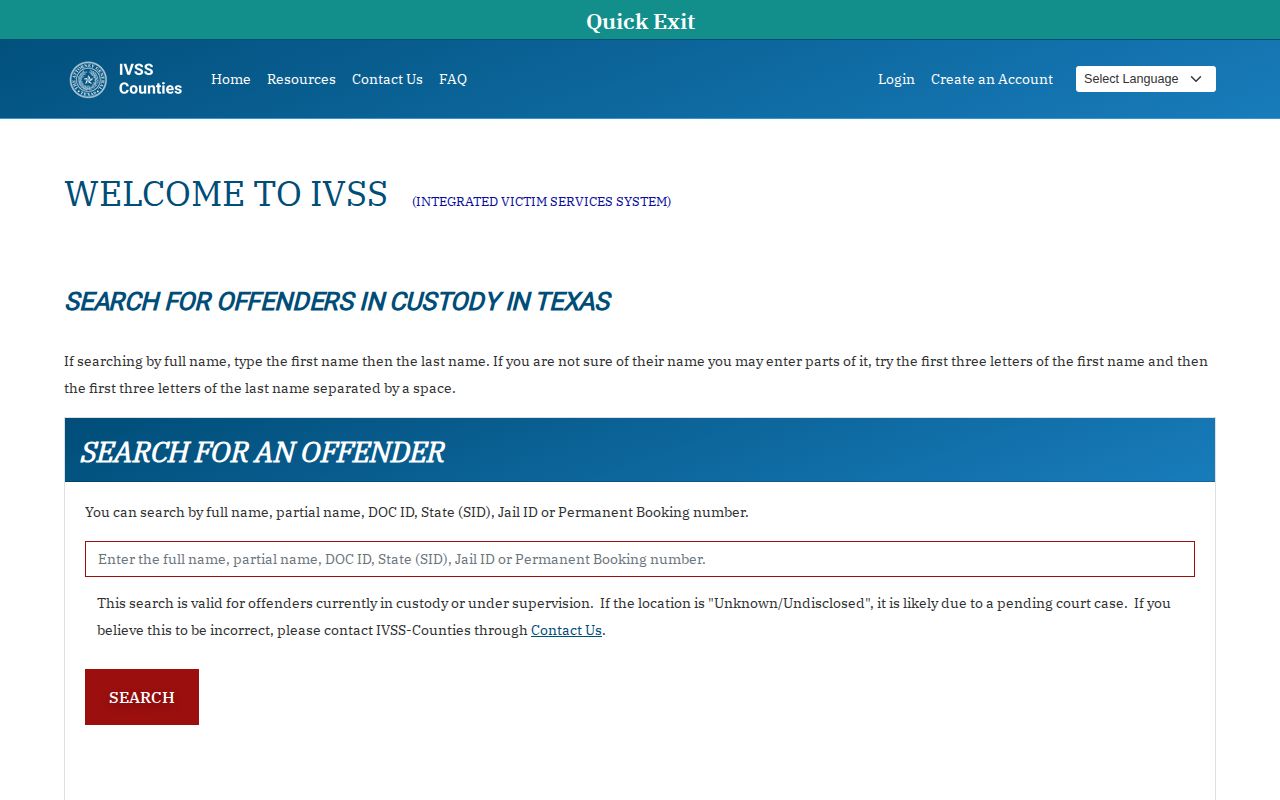
An alert can arrive near the event and help locate a relevant date. It should then be matched to the Sheriff's record and the receiving jail's physical exit. IVSS support is available at 866-268-8959 for participation and account questions.
Older instructions referring to Texas county VINE or a four-digit phone PIN describe the former workflow. They should not be used as current registration directions. The live IVSS portal controls present account options, notification channels, and county availability. Even when an alert is prompt, save the event details and request the source custody record for a durable account of the result.
Foard Release Systems Over Three Days
County, state, and federal records cover different custody systems. The TDCJ public search only includes people currently incarcerated in a TDCJ facility. A former prisoner normally disappears from that search, so TDCJ information or public-information records, parole channels, and the court file are needed after a completed state-prison release.
A federal sentenced prisoner belongs in the Bureau of Prisons locator, where a past date and `RELEASED` location indicate the person is no longer in BOP custody. ICE uses its own locator for current custody and some recent releases. Neither route turns a Foard transfer into immediate community freedom. For every system, identify the custodian and reconcile the three-day event with the agency record.
- Release
- A physical or legal end to a particular custody event; the destination determines whether the person entered the community.
- Transfer
- A move from one custodian to another, not freedom from confinement.
- Discharge
- Completion of a sentence or supervision obligation as recorded by the responsible agency.
- Detainer
- A request or authority that can cause another agency to hold or receive a person.
Public Record Search
Sponsored Results