
Foard Parole and Probation Compared
Parole is conditional release from a Texas prison before the sentence has fully expired. The Texas Board of Pardons and Paroles makes the release decision, while the Texas Department of Criminal Justice Parole Division carries out supervision. Mandatory supervision is a separate statutory release route, but TDCJ also supervises it. Probation, formally called community supervision in Texas, is imposed by a court instead of prison or after a short confinement term authorized by the judgment.
The two records therefore come from different custodians. A Foard conviction that led to TDCJ may produce a parole or mandatory-supervision record. A Foard court order placing someone on adult community supervision routes to the 46th Judicial District Community Supervision and Corrections Department. Neither office is a general jail-release desk.
| Point | Parole or mandatory supervision | Probation |
|---|---|---|
| Source | TDCJ prison release | Court sentence |
| Decision authority | Texas Board of Pardons and Paroles or statute | Sentencing court |
| Foard office route | Wichita Falls District Parole Office | 46th Judicial District CSCD in Vernon |
| Core proof | TDCJ release type and supervision record | Judgment, docket, and CSCD confirmation |
Verify Foard Post-Release Supervision
Start with a full name, date of birth, and any TDCJ, state identification, cause, or booking number already known. A current-custody search is not enough. The public TDCJ inmate search covers people now incarcerated in a TDCJ facility. A person who has been released may no longer appear there, so the release record, Parole Division, and court file become more useful.
- Identify whether the person left a county jail, a TDCJ unit, or received a community sentence directly from court.
- For a TDCJ route, check current status, then contact TDCJ offender information or the Wichita Falls parole office with the exact identifiers.
- For probation, locate the judgment through the Foard County or District Clerk and contact the 46th Judicial District CSCD.
- Ask whether supervision is active, discharged, transferred, revoked, or subject to an unresolved status that the office can lawfully confirm.
- Pair the supervision response with the actual release or court record. A roster absence or parole vote is not proof of physical release.
Foard Parole Routes to Wichita Falls
TDCJ's county-to-district-parole-office list maps Foard County to the Wichita Falls District Parole Office. The Region V directory lists that office at 3915 Call Field Road, Wichita Falls, TX 76308, with telephone 940-766-1676. This regional assignment is the key local detail. There is no sourced Crowell parole office for a Foard parolee.
The county mapping is visible in the official TDCJ source below. It helps route a question after a state-prison release, but it does not show an individual's status by itself.
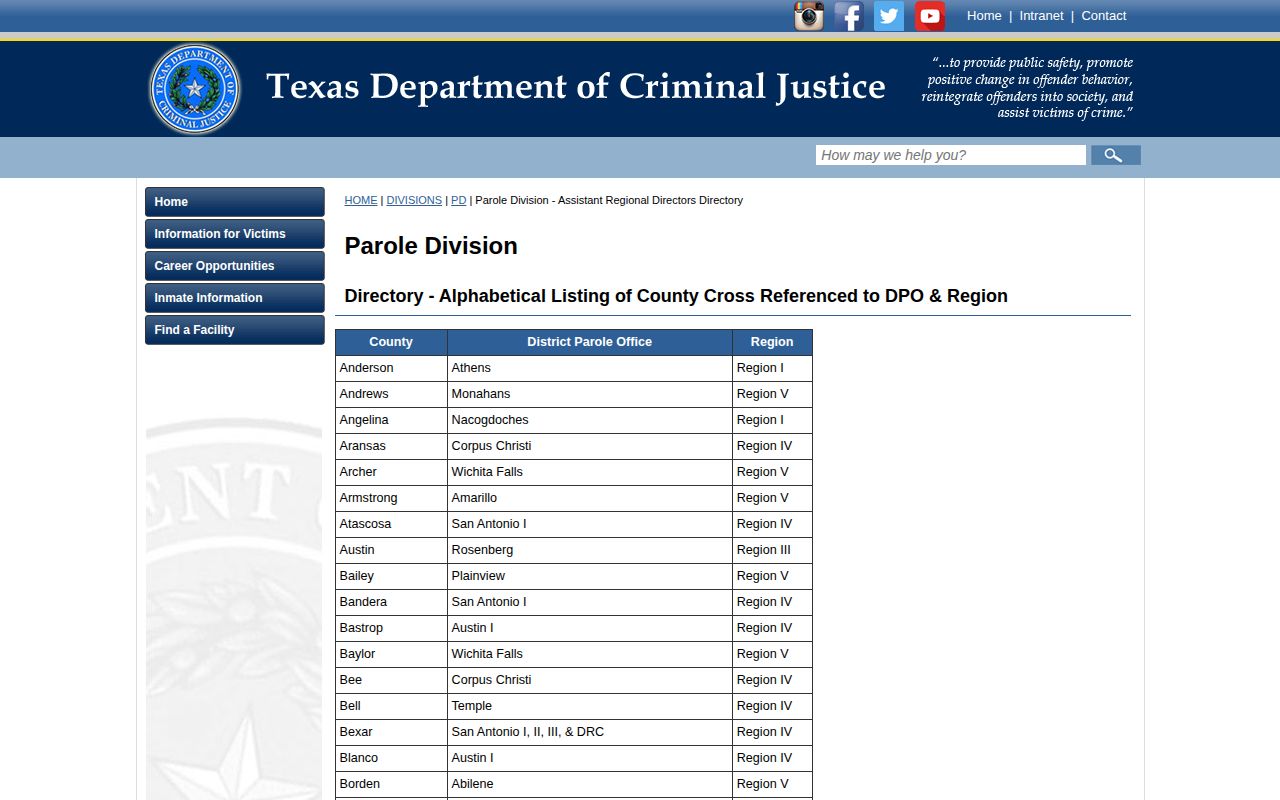
The row should be used with the Region V contact listing and the person's TDCJ identifiers. Supervision can sometimes transfer, so the listed office should confirm the current assignment.
Wichita Falls District Parole Office3915 Call Field Road
Wichita Falls, TX 76308
940-766-1676
For statewide parole information, TDCJ also lists parole information contacts and an Board ombudsman route for review-status concerns. Those channels address state cases, not county probation.
Foard Probation Routes to Vernon
Adult probation for Foard County is regional as well, but it uses a different city and agency. The 46th Judicial District CSCD serves the district from 1700 Wilbarger Street, Room 33, Vernon, TX 76384. Its listed telephone is 940-553-1271. Office hours are Monday through Friday, 8:00 a.m. to noon and 1:00 p.m. to 5:00 p.m.
The official contact block shown below is useful when a judgment says community supervision or when the court clerk confirms an active probation case.
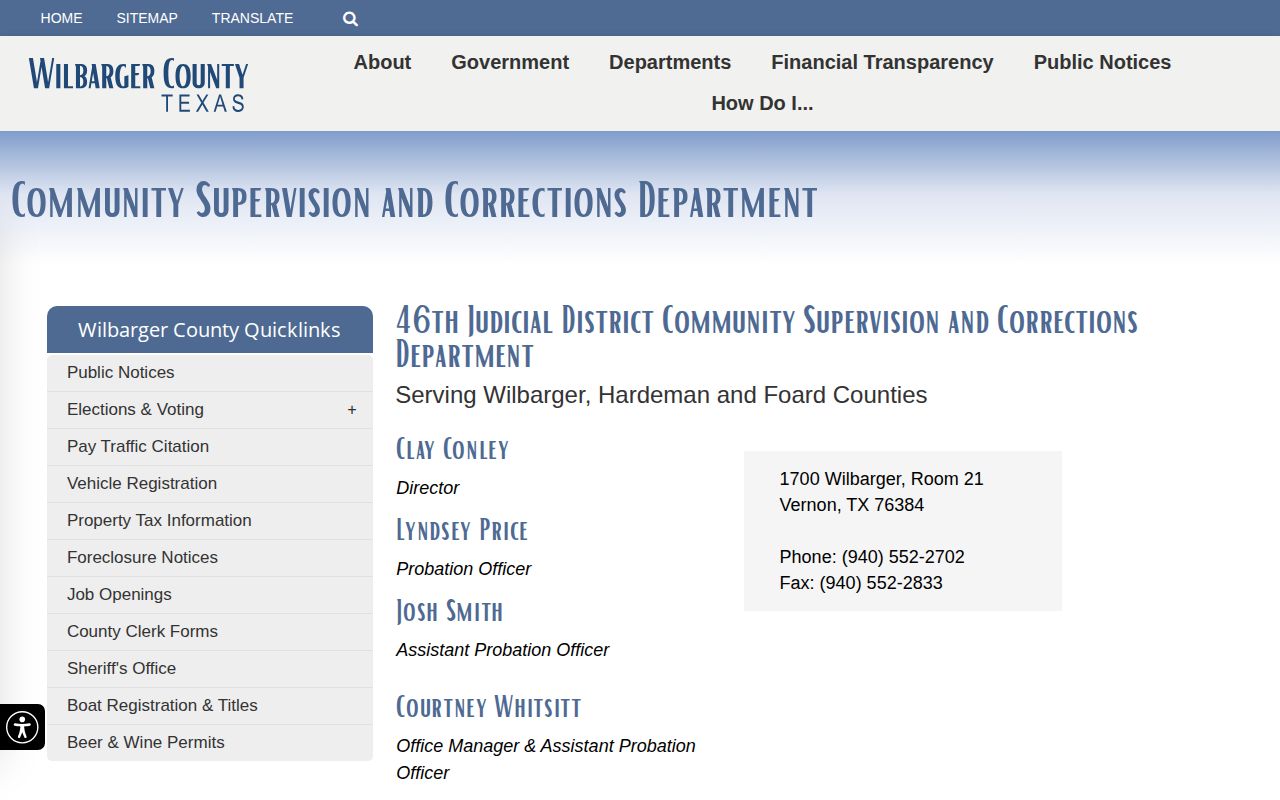
This office should not be asked to verify TDCJ parole merely because both are forms of supervision. Give the cause number and court level when possible.
46th Judicial District CSCD1700 Wilbarger Street, Room 33
Vernon, TX 76384
940-553-1271
Monday-Friday, 8 a.m.-noon and 1-5 p.m.
Foard County's district and county court files remain distinct even though local clerk roles overlap. The judgment identifies the sentence, term, conditions, and court authority. The CSCD record then confirms reporting and current supervision administration.
Note: A court order can establish probation while the CSCD supplies the current reporting and discharge status.
Foard Parole Reviews Lack Hearings
Texas does not hold a formal, calendarized hearing for each parole case. The Board's parole-panel FAQ says parole and mandatory-release cases are reviewed as files. The Parole Division generally starts an initial review about six months before eligibility and a later review about four months before the scheduled review. These are working time frames, not firm release dates.
The official explanation below prevents a common mistake: open-meeting notices are not personal parole-hearing calendars.
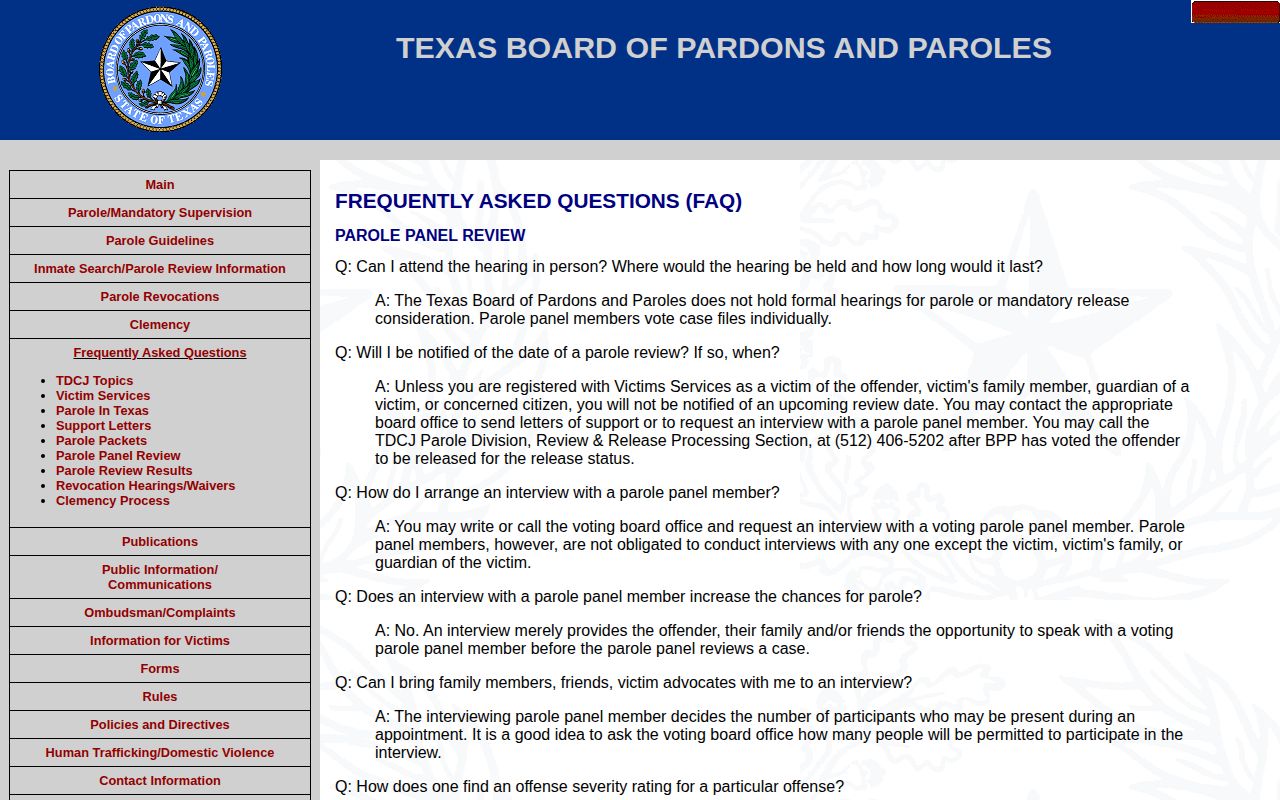
A three-member panel votes, and two concurring votes create the decision. Interviews are discretionary. Notice of a favorable vote still does not establish gate release because a program, detainer, release plan, or final processing step may remain.
The official vote-code definitions distinguish immediate or future favorable actions, program-related actions, mandatory supervision, denial with another review date, and serve-all outcomes. Codes should never be turned into a guessed release day. For a current prisoner, the Board status line or 844-512-0461 may help; after a favorable vote, TDCJ lists 512-406-5202 for release processing.
Foard Supervision Terms and Violations
Conditions vary with the judgment, release certificate, offense, and assessed needs. They may govern reporting, travel, treatment, contact, fees, or other conduct. Only the supervising office and controlling document can state the actual terms. A missed report or alleged violation does not, by itself, explain the legal outcome. The agency and court or Board must follow the applicable process.
- Parole
- Conditional community release from prison under Board authority.
- Probation
- Court-ordered community supervision, often used instead of imprisonment.
- Mandatory supervision
- A statutory TDCJ release form for eligible cases, distinct from discretionary parole.
- Absconder
- A supervised person alleged to have stopped reporting or left supervision without approval.
- Discharge
- The formal end of the sentence or supervision term.
TDCJ maintains an absconder information page, but a public listing must be read in context and checked with the agency. A warrant or violation status can change. Local probation warrant questions belong with the CSCD and issuing court, not the parole absconder channel.
Supervision can end by successful discharge, expiration, early court action where authorized, revocation, or another case-specific order. The best record states the date and authority. A person simply ceasing to appear in a public tool is not enough.
Release type also matters. Discretionary parole follows a Board vote. Mandatory supervision is a statutory release route only when the person and offense qualify. A direct discharge can end the sentence with no post-release parole term. Read the TDCJ release certificate and the official release-type definitions before calling a district office. They show whether the Wichita Falls DPO should have an active role.
A supervision record can include the supervising region, start date, scheduled end date, release form, transfer information, and status. Access is not identical for every field. Ask for the releasable record instead of demanding a conclusion from front-desk staff. If a public-information request is needed, identify the person and date range, name the record, and request an electronic copy.
The release record and supervision record answer separate questions. One proves when and how custody ended. The other shows whether oversight began, where it is assigned, and whether it later ended. Request both when the timeline matters, and keep each agency's date and identifier attached to its own document.
Legal Help After Foard Release
The TexasLawHelp Wichita Falls Free Legal Advice Clinic expressly includes Foard County in its service area. Its listing describes a recurring first-Monday general civil intake. This is a regional navigation option when a released person needs advice about a civil issue tied to reentry or records.
The listing does not promise criminal representation, record clearing, or acceptance of any one matter. Call first and describe the issue in plain terms. For a supervision rule, deadline, alleged violation, or criminal-case question, seek advice from a lawyer who can review the actual judgment and release papers. Agency staff can explain reporting logistics, but they do not replace legal counsel.
A broader Foard County released-inmate search can help identify the custody and court route before choosing an office. Keep copies of release certificates, judgments, notices, and contact logs. They prevent parole, probation, and a bare jail discharge from being blended into one status.
The court file can resolve routing facts before legal intake. A felony judgment from the 46th Judicial District should be requested from the District Clerk. A county-level matter belongs with the County Clerk. Ask for the judgment, sentence, any order changing community supervision, and the cause-number docket. A jail record can then establish whether and when the person physically left custody.
For a TDCJ case, preserve the offender number and county of conviction. Those fields help separate people with similar names. If a Board vote is pending, do not report the person as released. If a favorable vote has issued, ask release processing whether a program, plan, or hold remains. After the gate event, ask the DPO whether supervision began and which office now owns the case.
Note: The regional clinic is an intake lead, not a guarantee of representation or a specific legal result.